The complete guide to gravel driveways for Shropshire homeowners — gravel types, angular vs rounded, real costs per m², edging, installation, slopes, SuDS planning permission, and how gravel compares to resin, block paving and tarmac.
Gravel Driveways in Shropshire: The Complete Cost, Types & Installation Guide
Gravel driveways have made a serious comeback. Once seen as the budget option, a well-designed gravel driveway is now a feature in its own right — natural, characterful, and a perfect match for Shropshire's rural and suburban properties alike.
With the right stone, proper edging, and a solid sub-base, a gravel driveway looks beautiful, drains naturally, and costs a fraction of resin, block paving, or tarmac. Get it wrong, though, and you'll end up with ruts, weeds, and gravel migrating across your garden within months.
This guide gives you the honest, practical information you need to choose the right gravel driveway for your Shropshire home — from gravel types and costs to edging, installation, and long-term maintenance. We've been building gravel driveways across Shrewsbury, Telford, Ellesmere and Oswestry for over 25 years, so this is what actually works.
Why Choose a Gravel Driveway?
Gravel remains one of the most popular driveway surfaces in the UK, and for good reason:
- Affordable — the lowest-cost driveway option per square metre
- Natural drainage — fully permeable, so no planning permission issues with SuDS
- Character — natural stone that complements both period and modern homes
- Low maintenance — occasional raking and topping-up keeps it looking good
- Flexible — easy to adapt to any shape, slope, or layout
- Quiet security — the crunch of gravel underfoot is a natural deterrent
For Shropshire homeowners watching the budget — or wanting a natural, rustic look that resin and tarmac simply can't match — gravel is hard to beat.
Types of Gravel for Driveways
Not all gravel is created equal. The stone you choose affects the look, the feel underfoot, and how well the driveway performs over time.
Golden Gravel (Cotswold / Golden Pea)
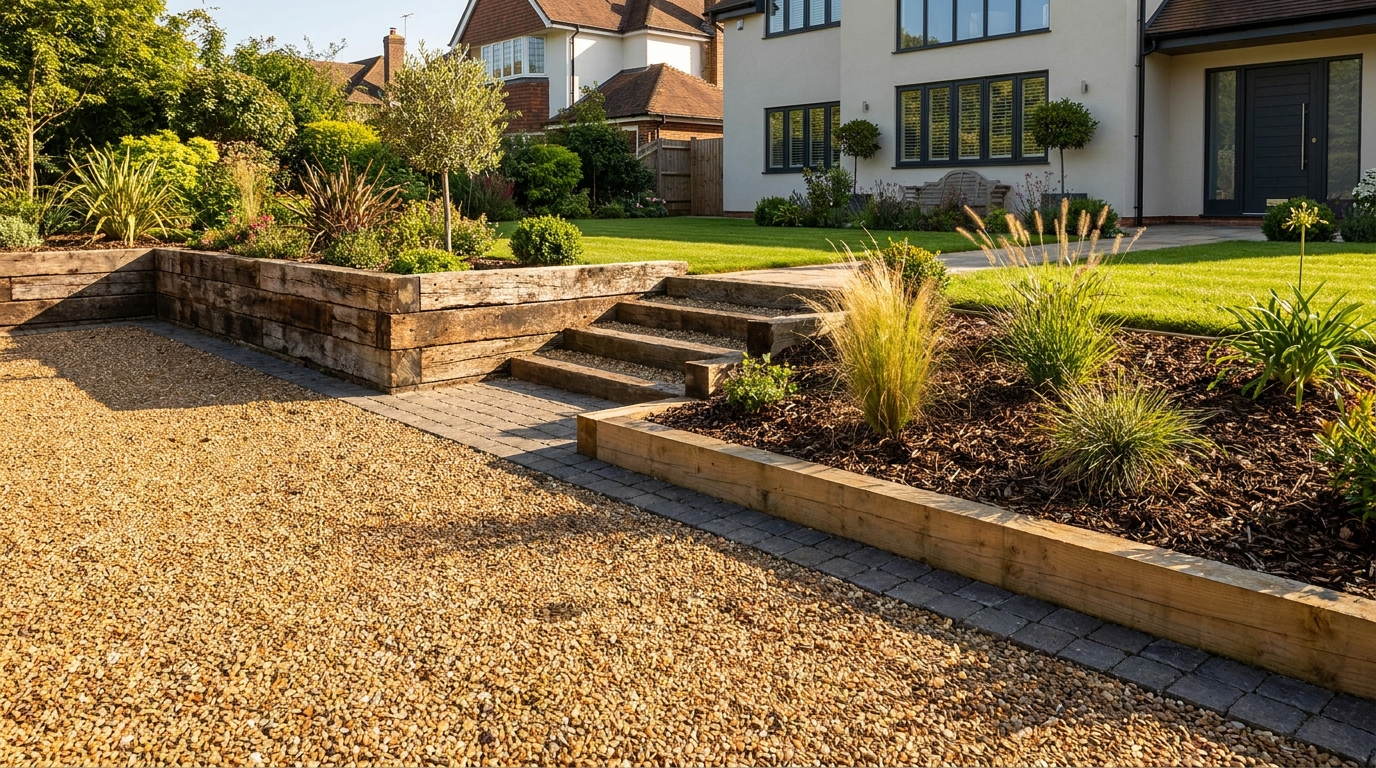
Warm, honey-toned rounded stones — the gravel shown in the driveway above. Bright, cheerful, and a beautiful match for brick and rendered properties. One of our most popular choices.
Grey Granite Gravel
Sharp, contemporary, and hard-wearing. A cool, neutral grey that suits modern homes and works beautifully with charcoal edging.
White / Polar White Gravel
Bright, clean, and striking. Makes a bold statement and reflects light — great for darker driveways. Best in sheltered spots as it shows dirt more easily.
Cotswold Stone
Creamy, buff-toned angular stone. Classic and timeless, suits period and cottage properties.
Slate Chippings
Flat, dark charcoal or plum slate pieces. Contemporary and dramatic — more suited to pathways and decorative areas than heavy vehicle use.
Pea Shingle
Small, rounded, mixed-tone stones. Affordable and traditional, but can migrate more than angular gravels — best with strong edging.
Self-Binding Gravel
A specially graded gravel that compacts to form a firm, near-solid surface. The best choice if you want the look of gravel with minimal movement — ideal for sloping driveways and heavier use.
Angular vs Rounded Gravel: Why It Matters
This is the single most important detail most homeowners overlook:
- Angular gravel (granite, crushed stone) locks together when compacted. It stays in place, resists ruts, and is the right choice for driveways that take vehicle traffic.
- Rounded gravel (pea shingle, river stone) rolls and moves. It looks lovely but ruts easily under car wheels and migrates across the surface.
For a driveway that takes regular vehicle use, always choose an angular, self-binding or crushed gravel. Rounded gravels are better reserved for paths and decorative borders.
We bring samples to your free site survey so you can see and feel the difference.
How Much Does a Gravel Driveway Cost in Shropshire?
Gravel is the most affordable driveway surface. Costs depend on the size, the gravel you choose, the condition of the existing drive, and the edging and detailing. As a guide:
| Driveway Size | Approximate Cost | |---|---| | 30 m² (small drive) | £900 – £1,500 | | 50 m² (average drive) | £1,400 – £2,400 | | 80 m² (large drive) | £2,200 – £3,800 | | 100 m²+ (extra large) | £2,800 – £4,800+ |
These figures include excavation, sub-base, weed membrane, the gravel itself, edging, and labour. Premium gravels (white, slate) and decorative edging add to the cost.
Gravel is roughly 50–60% cheaper than resin-bound or block paving, making it exceptional value for larger driveways.
The Edging: What Holds It All Together
A gravel driveway is only as good as its edging. Without strong edging, gravel spreads, migrates, and thins at the edges. The driveway above shows the difference good edging makes — crisp charcoal-grey paving stones contain the gravel and form a clean pathway to the sleeper steps.
Common edging options:
- Block paving / setts — crisp, formal, and available in a range of colours
- Steel edging — discreet, modern, and virtually invisible
- Timber sleepers — rustic, warm, and perfect for rural and cottage properties
- Stone setts — premium, traditional, and characterful
- Brick edging — affordable and classic
We always recommend a solid edging course — it defines the driveway, contains the gravel, and dramatically reduces maintenance.
The Installation Process: What Proper Gravel Laying Looks Like
A beautiful gravel driveway that lasts starts with proper ground preparation. Here's what a proper installation involves:
1. Excavation
We excavate to the correct depth — typically 150–200mm — to make room for the sub-base, membrane, and gravel layer. Skipping this is the #1 cause of rutting and sinking.
2. Type 1 MOT Sub-Base
A compacted Type 1 MOT hardcore sub-base is laid and compacted in layers. This provides a solid, stable foundation that distributes the weight of vehicles and prevents the driveway from deforming.
3. Weed Membrane
A heavy-duty weed control membrane is laid over the sub-base. This prevents weeds growing up through the gravel — a common problem on cheap, rushed installations.
4. Edging Installation
Edging is installed and haunched with concrete to lock it firmly in place. This contains the gravel and defines the driveway's shape.
5. Gravel Layer
The gravel is spread evenly to a depth of 40–50mm and lightly compacted. We use the right depth for the gravel type — too shallow and it looks patchy, too deep and vehicles sink.
6. Finishing & Tidying
Excess gravel is swept, edges are detailed, and the site is left clean and ready to use.
Gravel Driveways on a Slope
Gravel can work on sloping driveways, but it needs extra care. On steeper slopes, rounded gravel will migrate downhill and collect at the bottom. Solutions include:
- Self-binding gravel — compacts to a near-solid surface that resists movement
- Gravel grids / cellular systems — plastic grids that hold the gravel in individual cells
- Terracing with sleepers or edging — breaks the slope into level sections
- Angular gravel — locks together better than rounded stone
We assess every slope during your free survey and recommend the right approach for your garden.
Gravel vs Resin vs Block Paving vs Tarmac: The Honest Comparison
How does gravel stack up against the other driveway surfaces?
| Material | Cost (m²) | Look | Maintenance | Lifespan | |---|---|---|---|---| | Gravel | £40–£60 | Natural, rustic | Medium | 10–20 years | | Resin-bound | £70–£100 | Modern, seamless | Low | 20+ years | | Block paving | £70–£100 | Classic, patterned | Medium | 20+ years | | Tarmac | £50–£80 | Plain, functional | Low | 15–20 years | | Concrete | £60–£90 | Plain, modern | Low | 20–30 years |
Gravel is the most affordable option and the only one that offers genuine natural drainage and rustic character. The trade-off is slightly higher maintenance.
Maintaining Your Gravel Driveway
Gravel is low-cost but not zero-maintenance. A little regular care keeps it looking its best:
- Rake occasionally — redistributes the gravel and levels any ruts or hollows
- Top up every 1–2 years — add a fresh layer to keep the depth consistent
- Treat weeds promptly — a weed membrane prevents most, but the occasional weed will appear; pull them young
- Keep edges clear — sweep displaced gravel back into the driveway
- Use a leaf blower carefully — clear leaves without blowing the gravel away
With this simple care, a gravel driveway stays beautiful for well over a decade.
Do You Need Planning Permission for a Gravel Driveway?
In most cases, no. Gravel is a fully permeable surface, so it complies with the SuDS (Sustainable Drainage Systems) regulations that apply to new driveways in England. These rules require that rainwater soaks into the ground rather than running off into the road.
Non-permeable surfaces (tarmac, concrete, block paving without drainage) over 5m² require planning permission if the water runs onto the road. Gravel sidesteps this entirely.
If your driveway slopes towards the road, we'll advise on drainage during your free survey to ensure full compliance.
Frequently Asked Questions
Is a gravel driveway messy?
Gravel can spread if not properly edged, but with strong edging and the right gravel depth, migration is minimal. Angular gravel and self-binding gravels stay in place far better than rounded pea shingle.
Can I park a car on a gravel driveway?
Yes — provided the sub-base is properly prepared and the gravel is angular or self-binding. Rounded pea shingle is not suitable for regular vehicle use as it ruts and moves.
How deep should gravel be on a driveway?
Typically 40–50mm after compaction. Too shallow and the membrane shows through; too deep and vehicles sink into it. We calculate the right depth for your chosen gravel during installation.
Does gravel get weeds?
A heavy-duty weed membrane prevents most weeds, but seeds can still germinate in the gravel layer itself. A quick weed-pull a couple of times a year keeps it weed-free.
Is gravel noisy?
Gravel crunches underfoot and under tyres — which many homeowners actually like as a natural security feature. It's not suitable if you need a perfectly quiet surface.
Can gravel be laid over tarmac or concrete?
It's possible, but only if the existing surface is sound, level, and has the correct fall. We assess the existing surface during your free survey and advise on the best approach.
Get Your Free Gravel Driveway Quotation
If you're considering a gravel driveway for your Shropshire home, book a free, no-obligation site survey. We'll:
- Assess your driveway and ground conditions
- Bring gravel samples in a range of colours and textures so you can see them against your property
- Measure the area and provide an itemised quotation
- Answer any questions about edging, installation, and maintenance
With 25 years of experience and hundreds of driveways installed across Shrewsbury, Telford, Ellesmere and Oswestry, we have the expertise to create a gravel driveway you'll love coming home to.
Get your free quote today.
Ready to transform your garden?
Get a free, no-obligation quotation and site survey from our experienced team.
Get Your Free Quote