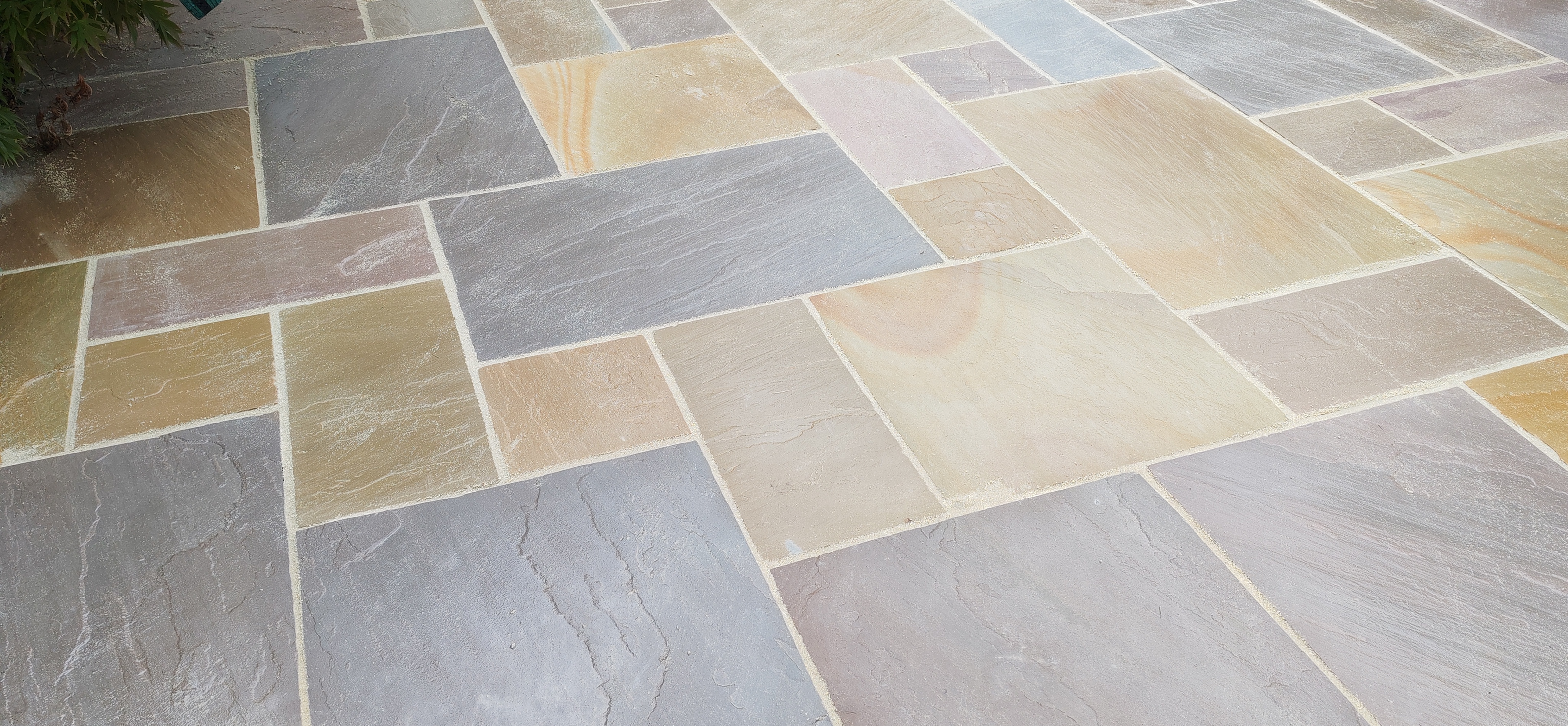
Everything you need to know about Indian sandstone patios in Shropshire — costs per m², Raj Green vs Kandla Grey, sealing, maintenance and how to choose a local installer you can trust.
Indian Sandstone Patios: The Complete Guide for Shropshire Homeowners
Indian sandstone is still the most popular natural paving in Britain, and in Shropshire it is the patio surface we install more than any other. It is warm, characterful, hard-wearing and — laid properly — it looks better in ten years than the day it went down.
This guide answers the questions Shropshire homeowners ask us most often: what Indian sandstone actually is, which colour blend suits your house, what a patio costs per square metre in 2026, whether you need to seal it, and how to spot an installer who will do the job properly.
What is Indian sandstone?
Indian sandstone is a natural sedimentary stone quarried in Rajasthan, northern India, and cut into paving slabs for the UK market. Each slab is a slice of a natural rock bed, which is why no two slabs are identical — you get subtle shifts of colour, mineral veining and a slightly riven (textured) surface that no manufactured paving can copy.
It has been the go-to patio stone in Britain since the 1990s, and for good reason: it is hard-wearing, frost-resistant, comparatively affordable for natural stone, and it weathers beautifully. A well-laid Indian sandstone patio in Shrewsbury or Telford will comfortably deliver 25 to 30 years of service.
The two finishes you will be offered are:
- Riven (natural) finish — the classic textured, hand-split surface with natural undulation. Traditional, exceptionally grippy underfoot and the most popular choice in Shropshire.
- Sawn, honed or sandblasted finish — machine-cut smooth surfaces with straight, tight edges. Contemporary, cleaner-lined and ideal for modern extensions and porcelain-style looks with the warmth of real stone.
Why Indian sandstone works so well in Shropshire gardens
Our county throws everything at a garden: wet winters, shaded north-facing plots, heavy clay soil in the Severn valley, and slopes in the hills around Oswestry and Much Wenlock. Indian sandstone deals with all of it:
- It grips when wet. The riven surface is naturally slip-resistant, which matters on a wet patio in February.
- It does not fade. Colour is in the mineral body of the stone, not a surface coating.
- It is repairable. Individual slabs can be lifted and replaced if ever damaged.
- It ages gracefully. Instead of looking scruffy, well-sealed sandstone mellows into a desirable patina.
- It suits period and modern properties alike. A Raj Green blend looks superb against Shropshire brick, timber and render.
Which Indian sandstone blend should you choose?
Colour is the decision most homeowners agonise over, so here is the short version:
- Raj Green — soft greens, buffs and greys. The most versatile blend and our most-requested in Shropshire. Works with brick, stone, render and timber.
- Autumn Brown — warm browns, buffs and occasional plum tones. Rich and traditional; ideal for period cottages and red-brick homes.
- Kandla Grey — cool blue-greys with buff tones. The most contemporary of the classic blends and very popular on modern new-builds.
- Raj Blend — a mix of greens, browns, buffs and greys for maximum natural character and variation.
- Fossil Mint — warm buff with delicate fossil markings and occasional pink hints. Unusual, characterful and very attractive on country properties.
- Sawn sandstone, honed sawn and cobble setts — smoother, more architectural finishes for contemporary schemes, and cobbles for edging and feature paths.
Our advice: ask to see the stone wet rather than dry. Indian sandstone darkens by one to two shades in the rain, and a blend that looks pale and wishy-washy dry can look beautiful once wet.
How much does an Indian sandstone patio cost in Shropshire?
As a realistic 2026 guide, an Indian sandstone patio supplied and fully installed in Shropshire typically starts from around £70 to £110 per m², with the final figure depending on:
- The stone — standard riven blends sit at the lower end, sawn and honed finishes, thicker 25mm-plus paving and premium blends at the upper end.
- Area size — larger patios cost less per square metre because excavation, delivery and set-up are spread across more square metres.
- Ground preparation — the single biggest variable. Easy access over flat ground is one price; removing an old patio, digging out heavy clay, carting spoil through the house or building retaining levels is quite another.
- Complexity — steps, circles, chamfered corners, decorative borders and mixed levels all add time and skill.
- Drainage — new ACO channels, soakaways or connection into existing drainage.
Why the wide range? Because the price of a patio is really the price of the groundwork underneath it. A cheap quote usually means a thin or skipped sub-base, dot-and-dab bedding instead of a full mortar bed, or no proper falls for drainage — and that is how patios end up with rocking slabs, ponding water and joint failure within a couple of winters.
We always provide a free site survey and an itemised written quotation, so you can see exactly what you are paying for: excavation, type 1 MOT sub-base, bedding, laying, cutting, sealing and pointing.
Sealing: do you really need it?
Yes — and here is why. Indian sandstone is porous. Left unsealed, it will absorb water, moss, algae and any oil or wine spill that lands on it, and it will darken unevenly over time. A good quality breathable impregnating sealer:
- Repels water, oil and staining
- Keeps the colour rich instead of fading to grey
- Makes cleaning dramatically easier
- Reduces moss and algae growth in damp, shaded Shropshire gardens
We recommend sealing after installation and then re-sealing every two to three years. It is a quick job and it is the single most effective thing you can do to protect your investment.
How to maintain an Indian sandstone patio
Maintenance is genuinely simple:
- Sweep regularly — leaves and soil left in the joints turn into a seed bed for weeds and moss.
- Wash with warm soapy water a few times a year, and use a stone-safe cleaner for algae.
- Re-seal every two to three years to keep the surface repelling water.
- Re-sand or re-point joints as needed, particularly on riven paving where joints can weather.
- Avoid acid-based or aggressive cleaners, and never pressure wash at a pinpoint setting — a wide fan on low pressure is all a sandstone patio ever needs.
Avoid the classic own-goal of jet washing at maximum pressure from six inches away, which strips the surface and blasts the pointing out of the joints.
How long does installation take?
A typical 30 to 50 m² Indian sandstone patio takes around 4 to 6 working days from excavation to final pointing: one to two days for groundwork and sub-base, two to three days laying and cutting, then grouting, sealing and a full clean-down. Sawn and honed finishes with tight joints take slightly longer because of the precision required. Larger schemes with steps, retaining walls or drainage work take proportionally longer — and you will get a clear, written programme with your quotation.
How to choose a paving installer in Shropshire
A patio is 20% stone and 80% groundwork, so the installer matters more than the slab. Before you commit, check that your contractor:
- Digs a proper sub-base — type 1 MOT compacted in layers, not a thin sprinkling of hardcore.
- Lays on a full mortar bed, never dot-and-dab or spot bedding.
- Builds in correct falls — around 1:60 away from the house so water sheds and never pools against your walls.
- Haunches and concretes the edges so the patio cannot spread or drop.
- Hand-picks and blends the stone so your patio looks cohesive rather than randomly patchy.
- Provides a written, itemised quotation with no vague open-ended extras.
- Is insured and has a local track record you can look at.
Frequently asked questions
Is Indian sandstone slippery when wet?
The riven finish has excellent grip and is widely used around pools and steps. Choose textured finishes for shaded or north-facing areas, and keep the surface sealed and free of algae.
Will the colour fade?
No. The colour runs through the stone rather than sitting on the surface, so it will never fade as a print or coating might. It will weather and mellow gently, which most homeowners prefer.
Can you lay Indian sandstone over my existing patio?
Occasionally, if the existing base is sound, level and stable. In most cases we remove and rebuild so the levels, drainage and sub-base are correct. We will tell you honestly during the free survey.
Does an Indian sandstone patio need planning permission?
Generally no, provided the finished surface is not raised more than 300mm above the original ground level and is not on a highway boundary. Front garden hardstanding rules can differ, and we will advise on your specific property.
Is Indian sandstone better than porcelain?
They solve different problems. Indian sandstone gives you natural warmth, character and a softer, traditional look at a lower price per square metre; porcelain gives you a flawless, joint-minimal, near-zero-maintenance contemporary finish. Many of our Shropshire projects combine both.
What thickness should the paving be?
For a pedestrian patio, 22mm is standard. For driveways, heavy traffic or paving laid on pedestals, we use 25mm-plus, or a different material entirely if the load demands it.
Get a free Indian sandstone quotation in Shropshire
We have been designing and building Shropshire gardens since 2001, and we install Indian sandstone patios across Shrewsbury, Telford, Ellesmere, Oswestry, Whitchurch, Market Drayton, Malpas and the surrounding villages.
Every project starts with a free site survey and written quotation, plus an optional 3D design so you can see your finished patio — stone blend, edges, steps and levels included — before we break ground.
Request your free quotation or read more about our Indian stone patio service.
Fully insured · 3D design available · Local Shropshire installers · Free quotations
Ready to transform your garden?
Get a free, no-obligation quotation and site survey from our experienced team.
Get Your Free Quote