The complete guide to Indian stone paving for Shropshire homeowners — colours (Raj Green, Kandla Grey, Fossil Mint), finishes, real costs, installation, sealing, fading, and how it compares to porcelain and York stone.
Indian Stone Paving in Shropshire: The Complete Homeowner's Guide to Cost, Colours & Installation
Indian stone — also called Indian sandstone — has become the patio material of choice for Shropshire homeowners who want the natural beauty of real stone without the premium price tag of Yorkshire or Welsh slate. It's now one of the most popular paving materials in the UK, and for good reason.
But with so many colours, finishes, and quality grades on the market, it's easy to end up with a patio that fades, flakes, or just doesn't look right after a few years.
This guide gives you the honest, practical information you need to choose the right Indian stone for your Shropshire home — from colour and finish to cost, installation, and long-term care. We've been laying Indian stone patios across Shrewsbury, Telford, Ellesmere and Oswestry for over 25 years, so this is what we've learned.
What Is Indian Stone Paving?
Indian stone is natural sandstone quarried in India — most commonly from the Rajasthan region. It's a sedimentary rock formed over millions of years, which gives it a distinctive riven (textured) surface and natural colour variation that simply can't be replicated by manufactured concrete alternatives.
Each slab is unique, with its own blend of tones, natural veining, and subtle texture. That natural variation is exactly what makes Indian stone so desirable — no two patios are ever identical.
Why Indian Stone Over Manufactured Paving?
- Natural beauty — real stone with genuine colour variation and texture
- Durability — hard-wearing and weather-resistant, lasting 30+ years
- Value — significantly cheaper than Yorkshire or Welsh stone
- Variety — available in a huge range of colours and finishes
- Character — every slab is unique, giving a genuinely bespoke finish
The Colours of Indian Stone
One of the biggest draws of Indian sandstone is the range of natural colours. Here are the most popular choices for Shropshire homes:
Grey / Kandla Grey
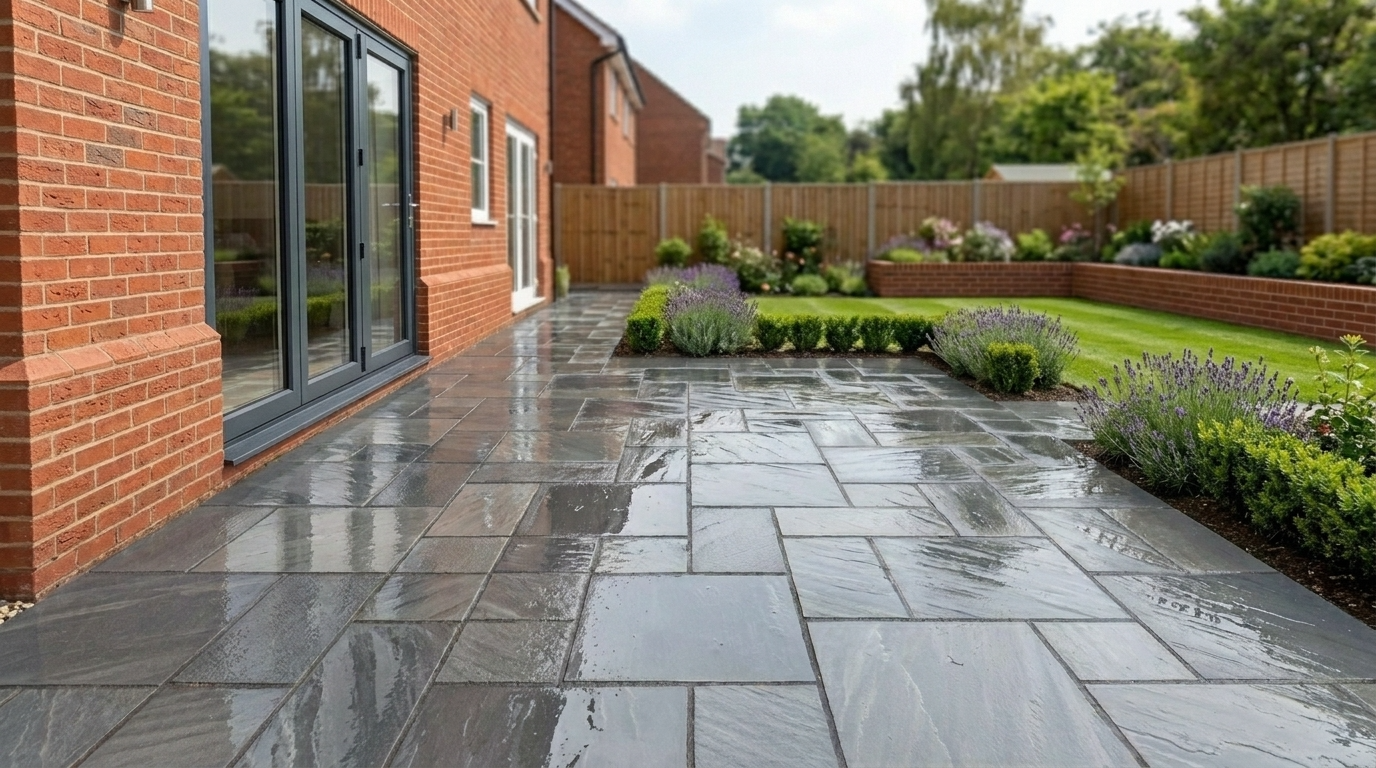
Cool, contemporary, and versatile. A blend of mid-grey and charcoal tones that suits both modern and traditional properties. One of our most popular choices — and the colour shown in the patio above.
Raj Green
A natural blend of green, brown, and grey tones that weathers beautifully. The most popular Indian stone in the UK, and a great match for Shropshire's rural landscape.
Autumn Brown
Warm browns, buffs, and occasional grey and pink tones. Classic and timeless, suits brick and stone properties.
Fossil Mint
A warm blend of buff, yellow, and minty green with occasional fossil markings. Bright and cheerful — great for smaller patios where you want to maximise light.
Kota Black
A consistent dark charcoal-grey slate. Sleek and contemporary, perfect for modern gardens. Hides dirt well and pairs beautifully with lighter garden features.
Rippon
A striking blend of buff, brown, plum, and grey — one of the most characterful Indian stones available.
Camel Dust
Soft buff and pink tones. Warm and subtle, ideal for traditional cottage gardens.
We bring sample slabs to your free site survey so you can see the colours against your property in natural daylight — colours always look different on a screen than they do in your garden.
The Finishes: Riven, Honed, and Sawn
Indian stone comes in several finishes, each suited to different uses:
Riven (Natural Textured)
The most common and affordable finish. The stone is split along its natural bedding plane, giving a textured, slightly uneven surface. Perfect for patios and paths. Excellent slip resistance.
Honed (Smooth)
The surface is machine-polished to a smooth, flat finish. Contemporary and elegant, but less slip-resistant — better suited to sheltered areas or indoor use.
Sawn & Sandblasted
The stone is cut square and sandblasted for a uniform, slightly textured finish. Modern, consistent, and ideal for contemporary designs. More expensive than riven.
Tumbled
Edges are tumbled to give a soft, aged, weathered look. Perfect for traditional and cottage-style gardens.
For most Shropshire patios, riven Indian stone offers the best balance of natural beauty, slip resistance, and value.
How Much Does an Indian Stone Patio Cost in Shropshire?
Indian stone patio costs depend on the size, the colour and finish you choose, the condition of the ground, and the detail work (steps, edging, circles). As a guide:
| Patio Size | Approximate Cost | |---|---| | 20 m² (small patio) | £1,600 – £2,400 | | 40 m² (average patio) | £2,800 – £4,200 | | 60 m² (large patio) | £4,200 – £6,000 | | 80 m²+ (extra large) | £5,600 – £8,000+ |
These figures include excavation, sub-base, bedding mortar, the stone itself, jointing, and labour. Premium finishes (honed, sawn) and decorative features (circles, borders) add to the cost.
Indian stone is roughly 30–40% cheaper than equivalent Yorkshire sandstone, making it exceptional value for a genuine natural stone patio.
The Installation Process: What Proper Laying Looks Like
A beautiful Indian stone patio starts long before the first slab is laid. The quality of the installation is what determines whether your patio is still flat and beautiful in 20 years — or starts sinking and shifting after the first winter.
Here's what a proper installation involves:
1. Excavation & Ground Preparation
We excavate to the correct depth — typically 150–200mm below finished patio level — to make room for the sub-base, bedding layer, and slab thickness. Poor preparation here is the #1 cause of patio failure.
2. Type 1 MOT Sub-Base
A compacted Type 1 MOT hardcore sub-base is laid and compacted in layers. This provides a solid, stable foundation that won't settle or sink. We never skip this step.
3. Bedding Layer
A full wet mortar bed (sharp sand and cement) is laid — not dot-and-dab, which causes hollow spots and cracking. Each slab is fully supported across its entire underside.
4. Laying & Levelling
Each slab is laid with a consistent joint width, tapped to level, and checked with a spirit level. Falls are built in to direct water away from the house.
5. Jointing
Joints are filled with a premium jointing compound — either traditional mortar or a modern permeable jointing sand that resists weeds and won't crack.
6. Cutting & Detailing
Slabs are cut with a diamond blade for clean edges. Steps, corners, and decorative features are finished to the same standard as the main area.
Indian Stone vs Porcelain vs Concrete: The Honest Comparison
How does Indian stone stack up against the other patio materials?
| Material | Cost (m²) | Look | Maintenance | Lifespan | |---|---|---|---|---| | Indian stone | £70–£100 | Natural, unique | Low | 30+ years | | Porcelain | £85–£120 | Modern, consistent | Very low | 30+ years | | York stone | £120–£180 | Premium natural | Low | 50+ years | | Concrete slabs | £40–£70 | Manufactured | Low | 15–20 years | | Sandstone (UK) | £90–£130 | Natural | Low | 30+ years |
Indian stone offers the best value of any natural stone — genuine beauty and durability at a fraction of the cost of premium UK stone.
Will Indian Stone Fade?
This is one of the most common concerns we hear. The honest answer: it depends on the quality.
Cheap, low-grade Indian stone — often sold at suspiciously low prices — can fade significantly in sunlight. The colours are sometimes artificially enhanced, and that enhancement washes out over a few seasons.
Quality Indian stone from reputable suppliers is naturally coloured and won't fade. The stone may weather slightly and develop a softer patina over the years — which most homeowners actually prefer — but the underlying colour remains.
We only source premium-grade Indian stone from established suppliers. You get the genuine, naturally coloured stone that will look as good in 15 years as it does the day it's laid.
Does Indian Stone Need Sealing?
Sealing is optional but recommended for most patios. A quality sealant:
- Protects against staining — oil, wine, and food wipe off easily
- Enhances the colour — brings out the natural tones
- Reduces algae and moss growth — makes cleaning easier
- Helps prevent frost damage — stops water soaking into the stone
We apply a premium penetrating sealer as standard on our installations. It needs reapplying every 3–5 years — a quick job we can do for you.
Caring for Your Indian Stone Patio
Indian stone is low-maintenance, but a little care keeps it looking its best:
- Sweep regularly — remove leaves and debris that can stain
- Wash occasionally — a pressure washer on a low setting, keeping the lance at least 30cm away, removes dirt and algae
- Re-seal every 3–5 years — maintains the protective barrier and colour
- Deal with spills promptly — wipe up oil, wine, and food before they soak in
- Avoid harsh chemicals — acid-based cleaners can damage the stone; use a pH-neutral cleaner
With this simple care, your Indian stone patio will stay beautiful for decades.
Frequently Asked Questions
Is Indian stone slippery when wet?
Riven Indian stone has a naturally textured surface that provides excellent grip, even in the rain. It's one of the safest natural stone options for outdoor use. Honed or polished finishes are smoother and less suitable for exposed areas.
How long does an Indian stone patio last?
A properly installed Indian stone patio should last 30 years or more. The stone itself is incredibly hard-wearing; the lifespan depends mostly on the quality of the installation and base preparation.
What's the difference between Indian stone and York stone?
Both are natural sandstones, but York stone is quarried in Yorkshire and is significantly more expensive (£120–£180/m² vs £70–£100/m²). Indian stone offers similar natural beauty and durability at a much lower price.
Does Indian stone need pointing?
Yes — the joints between slabs need filling with a jointing compound. We use premium permeable jointing sand that resists weeds and won't crack, or traditional mortar pointing depending on the look you want.
Can Indian stone be laid on concrete?
Yes, provided the concrete is sound and has the correct fall. We assess the existing surface during your free survey and advise on the best approach.
Is Indian stone ethically sourced?
We only buy from established, reputable suppliers who can demonstrate ethical sourcing. Cheap, untraceable stone is a red flag — both for quality and for ethical reasons.
Get Your Free Indian Stone Patio Quotation
If you're considering an Indian stone patio for your Shropshire home, book a free, no-obligation site survey. We'll:
- Assess your garden and ground conditions
- Bring sample slabs in a range of colours so you can see them against your property
- Measure the area and provide an itemised quotation
- Answer any questions about installation, sealing, and maintenance
With 25 years of experience and hundreds of natural stone patios installed across Shrewsbury, Telford, Ellesmere and Oswestry, we have the expertise to create a patio you'll enjoy for decades.
Get your free quote today, or learn more about our Indian stone patio service.
Ready to transform your garden?
Get a free, no-obligation quotation and site survey from our experienced team.
Get Your Free Quote