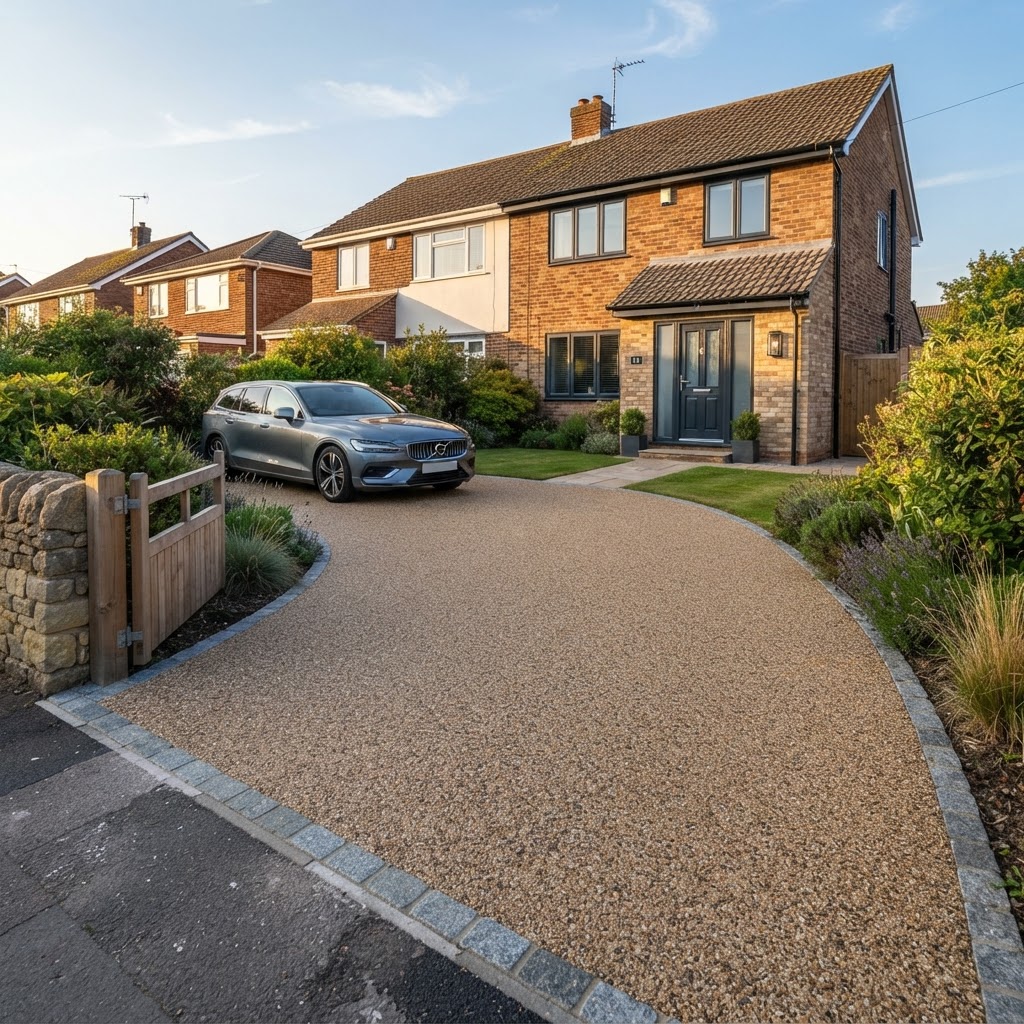
Can you lay resin-bound surfacing over your old tarmac drive and save the cost of excavation? Sometimes yes — here's exactly how to tell, and when you're better off starting from scratch.
Can You Lay Resin Over Tarmac?
It's one of the most common questions we get from Shropshire homeowners: "Can you just put resin over my old tarmac drive and save the cost of digging it all up?"
The honest answer is: sometimes yes, sometimes no — and getting it wrong is the single fastest way to ruin a resin driveway.
Here's exactly how we assess whether your tarmac is a suitable base for a resin overlay, and when you're better off starting from scratch.
The Short Answer
A resin-bound surface can be laid directly over an existing tarmac or concrete base if that base is sound, level, well-compacted and correctly drained. When those conditions are met, an overlay saves you the cost, mess and time of a full excavation.
When they're not met, laying resin over a failing base is throwing good money after bad — the resin will mirror every crack, dip and movement underneath, and fail within a few years.
When a Tarmac Overlay Works
Your existing tarmac is a good candidate for a resin overlay if:
- It's structurally sound — no widespread cracking, no soft or spongy areas, no crumbling edges
- It's reasonably level — no significant dips, ruts or camber issues that would show through the resin
- It's well-compacted — a tarmac drive that's been down 10+ years and is still solid has a proven sub-base
- It has proper falls — water already runs off rather than pooling on the surface
- There are no tree roots lifting or cracking the tarmac from below
- The surface is clean and dry — we'll power-wash and prime it before laying
If your tarmac ticks all those boxes, a resin overlay is a fantastic option. You get the seamless, weed-free, permeable finish of a brand-new resin drive at a lower cost and with a faster installation.
When It Doesn't Work (and What to Do Instead)
A resin overlay is not advisable if your tarmac shows any of these warning signs:
Widespread Cracking
If the tarmac is cracked across large areas, those cracks will telegraph straight through the resin within months. The resin doesn't bridge cracks — it follows them.
Soft or Spongy Areas
If the tarmac has soft spots (often where the sub-base has failed or water has eroded it underneath), the resin will flex and crack in exactly the same places.
Significant Dips or Rutting
Deep ruts from years of vehicle weight won't level out with a resin overlay. The resin follows the contours of the base — if the base is rutted, the finished surface will be too.
Poor Drainage
If water already pools on your tarmac, a resin overlay won't fix it. In fact, because resin-bound surfaces are permeable, water needs somewhere to go through the base — a non-permeable, puddle-prone tarmac is the wrong foundation.
Tree Root Damage
Roots that have lifted or cracked the tarmac will continue to grow. Resin over the top will crack again.
In any of these cases, the correct approach is a full excavation: dig out the old tarmac, lay a proper Type 1 MOT sub-base, a porous asphalt base course, and then the resin surface. It costs more upfront, but it's the only way to get a driveway that lasts 20+ years.
The Overlay Process: Step by Step
If your tarmac passes the assessment, here's how a resin overlay installation works:
- Assessment & Survey — We inspect the tarmac, check levels, drainage and structural integrity. Free of charge.
- Deep Clean — The surface is power-washed and any weeds, moss or oil stains are removed. The resin needs a clean, dry surface to bond to.
- Repairs — Small cracks or minor dips are filled or levelled with a suitable repair material.
- Edge Preparation — Existing edges are checked and reinforced where needed so the resin has a clean boundary.
- Priming — A bonding primer is applied to the tarmac to ensure the resin adheres properly.
- Resin Pour — The resin-bound aggregate is mixed on site and trowelled by hand to a smooth, seamless finish.
- Cure — The surface cures within 24–48 hours, after which you can walk and park on it.
Most overlay installations are completed in 1–2 days — significantly faster than a full excavation.
The Cost Difference
A resin overlay over sound tarmac is typically £15–£30 per m² cheaper than a full excavation and new sub-base, because you're skipping the dig-out and sub-base construction.
| | Overlay | Full Excavation | |---|---|---| | Cost | Lower | Higher | | Time | 1–2 days | 3–5 days | | Lifespan | 15–20 years* | 20+ years | | Best for | Sound existing base | Failed or no existing base |
*An overlay's lifespan depends entirely on the condition of the base underneath. If the tarmac is sound, the overlay will last just as long as a full installation.
How We Assess Your Tarmac — Free of Charge
We never recommend an overlay unless we're confident the base will support it. During your free site survey, we:
- Walk the entire driveway and check for cracks, soft spots and drainage issues
- Test the surface for movement and compaction
- Check the falls and identify any areas where water pools
- Look for tree roots, utility access points and edge conditions
- Give you an honest recommendation: overlay or full excavation
If the tarmac is suitable, we'll quote for the overlay. If it isn't, we'll tell you straight — and quote for the full excavation instead. No upselling, no guesswork.
Book Your Free Resin Driveway Survey
Not sure whether your tarmac is suitable for a resin overlay? That's exactly what our free site survey is for. We'll assess your existing surface, give you an honest recommendation, and provide an itemised quotation — with no obligation.
Get your free quote today, or learn more about our resin driveway service.
Ready to transform your garden?
Get a free, no-obligation quotation and site survey from our experienced team.
Get Your Free Quote