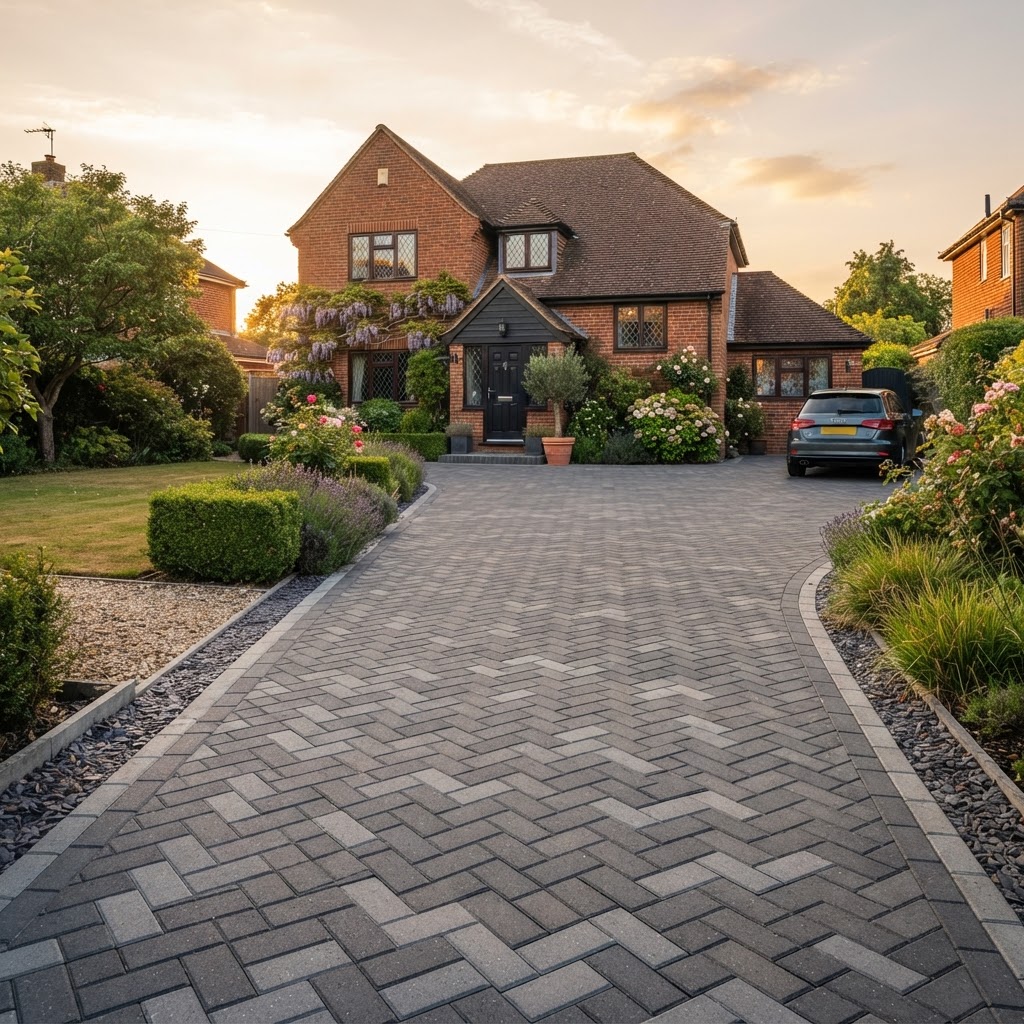
Why block paving remains Shropshire's favourite driveway — patterns, concrete vs clay, how to stop it sinking, weed management, and an honest comparison with resin.
Why Block Paving Is Still Shropshire's Favourite Driveway
Resin gets the headlines, but block paving quietly remains the driveway of choice for thousands of Shropshire homeowners — and for good reason. It's been the UK's most popular driveway surface for decades, and it hasn't stayed there by accident.
Here's why block paving endures, what to look for in a quality installation, and how to decide if it's the right choice for your home.
What Makes Block Paving Different?
A block-paved driveway is made from hundreds of individual bricks — concrete or clay — laid in a pattern on a compacted sand bedding course over a Type 1 MOT sub-base. The joints are filled with kiln-dried sand and the whole surface is compacted to lock everything together.
That modular structure gives block paving three unique advantages that no seamless surface can match:
- Repairability — individual blocks can be lifted and replaced if one is stained or damaged
- Service access — the entire drive can be lifted and re-laid to reach pipes or cables underneath, then put back exactly as it was
- Pattern & personality — herringbone, basket weave, stretcher bond, decorative borders and colour blends give you a driveway nobody else on your street has
The Patterns
The pattern you choose isn't just about looks — it affects strength too. Here are the most popular options for Shropshire homes:
Herringbone (45° or 90°)
The strongest pattern because the interlocking angles resist movement in all directions. Ideal for driveways that take vehicle weight. This is our default recommendation for most homes.
Stretcher Bond
A simple brick-running pattern. Clean and contemporary, but less interlocked than herringbone — better suited to paths and light-use areas than heavy vehicle traffic.
Basket Weave
A traditional, decorative pattern that suits period and cottage properties. Visually striking but not as structurally strong as herringbone.
Decorative Borders & Edging
Borders in a contrasting colour or material frame the driveway and add real kerb appeal. We can design custom borders to match your property's brickwork or stone.
Concrete Blocks vs Clay Pavers
Both are excellent, but they suit different homes and budgets:
| | Concrete Blocks | Clay Pavers | |---|---|---| | Cost | £70–£100/m² | £100–£150/m² | | Colour | Wide range, consistent | Natural earthy tones, may vary | | Durability | 20–25 years | 40+ years | | Fade | May fade slightly over time | Colour-fast (fired clay) | | Best for | Most homes | Period & high-end properties |
Concrete blocks are the practical all-rounder. Clay pavers are the premium choice — fired like bricks, they're harder, more durable and never fade, making them ideal for period properties or homeowners who want a driveway that lasts a lifetime.
The Secret to a Block Drive That Doesn't Sink
The single most common complaint about block paving is sinking — blocks dipping under vehicle weight, creating dips and puddles. This is never a problem with the blocks themselves. It's always a sub-base problem.
A block-paved driveway that doesn't sink requires:
- Excavation to the correct depth — typically 150–250mm below finished level, depending on ground conditions
- Type 1 MOT sub-base compacted in layers (not dumped in one go)
- A geotextile membrane to stop the sub-base mixing with the soil below
- Properly haunched edge courses — edge blocks set in concrete so the drive never spreads outward
- Kiln-dried jointing sand brushed in and compacted until every joint is completely full
We've spent 25 years laying block paving across Shropshire, and we never skip any of these steps. It's the difference between a drive that's still flat in 15 years and one that starts dipping in year two.
What About Weeds?
The other common worry with block paving is weeds growing in the joints. Here's the reality:
Weeds don't grow through properly installed block paving — they grow from seeds that land on the surface and work their way into the joints. A well-maintained drive with full joints resists this naturally.
To minimise weed growth:
- Keep the joints topped up with kiln-dried sand — full joints leave no room for seeds
- Apply a joint stabiliser sealant that locks the sand in place and repels weed seeds
- Sweep regularly — removing debris before it breaks down into soil in the joints
- An occasional gentle pressure wash followed by re-sanding keeps the surface fresh
With basic maintenance, weed growth is minimal and easy to manage.
Choosing Your Colour
Block paving comes in a huge range of colours. The most popular choices for Shropshire homes:
- Charcoal / Brindle — dark, contemporary with subtle colour variation
- Buff / Gold — warm and traditional, suits brick and stone homes
- Red / Terracotta — classic for period and Victorian properties
- Grey / Silver — modern and clean for contemporary homes
- Brown / Autumn — rich and natural for a grounded look
- Multi-Colour Blend — mixed tones for character and texture
We bring sample blocks to your free site survey so you can see the colour against your property before deciding.
Block Paving vs Resin: The Honest Comparison
Both are excellent driveways — they just suit different priorities:
| | Block Paving | Resin-Bound | |---|---|---| | Look | Classic, patterned | Smooth, seamless | | Maintenance | Low (re-sand every 1–2 years) | Very low (sweep & wash) | | Weed resistance | Good with maintenance | Excellent (no joints) | | Repairability | Excellent (lift & replace) | Limited | | Cost | £70–£100/m² | £75–£100/m² | | Lifespan | 20–25 years | 20+ years |
Choose block paving if you want patterns, borders, repairability and a classic look. Choose resin if you want seamless, zero-maintenance and modern kerb appeal.
How Long Does Installation Take?
An average driveway of 50–80 m² takes 4–6 days:
- Day 1–2 — excavation and Type 1 MOT sub-base, compacted in layers
- Day 3 — edge courses set in concrete, bedding course levelled
- Day 4–5 — block laying, cutting to edges and borders
- Day 6 — sanding, compaction and final clean
We keep the site tidy and accessible throughout, and your drive is ready to park on as soon as the final compaction is done.
Get a Free Block Paving Quotation
If you're considering block paving for your Shropshire home, book a free site survey. We'll assess your ground conditions, bring colour and pattern samples, and give you an honest, itemised quotation — with no obligation.
Get your free quote today, or learn more about our block paving service.
Ready to transform your garden?
Get a free, no-obligation quotation and site survey from our experienced team.
Get Your Free Quote